

During the last two weeks, a couple of friends asked me the same question independently. Should they still be investing in our website? Their logic was reasonable. If AI chatbots are absorbing more and more queries, fewer people will visit their company sites. Data already proves it. So why invest money into it? Shouldn’t they rather redirect that budget toward showing up in ChatGPT and Gemini results.
I believe this framing is completely wrong and I explain why.
The traffic that disappears and the traffic that remains
Website traffic in B2B is not a monolith. We often treat it like one number on a dashboard but it’s actually two very different behaviors.
There’s informational traffic. Someone types “what is predictive maintenance” or “ERP vs CRM comparison” into Google, lands on your blog post, skims for 40 seconds and bounces. This traffic is dying fast. AI chatbots answers these questions instantly now. That blog post has likely lost its economic reason to exist. I don’t think this traffic is coming back and honestly I’m not sure it is something to regret. It was never that valuable to begin with. We were just used to counting it.
Then there’s the traffic that actually matters. A procurement lead comparing three vendors for a seven figure contract. An engineer looking into your technical specs and compatibility docs. A VP trying to understand your platform architecture before greenlighting a pilot. This traffic still goes to your website because it has to. You can’t close a complex B2B deal inside ChatGPT. The buyer needs your product catalog, your pricing structure, your compliance documentation, your configurators. AI can summarize what you do in a paragraph. It can’t replace the experience of actually engaging with what you sell. At least not for now.
So what’s actually happening? The first type of traffic is collapsing. The second is holding steady and maybe even growing a bit because AI is getting better at qualifying buyers and routing them toward relevant vendors. And what happens as a result is that total visits go down but average value per visit goes up. I see some people panicking at the fact that the number of sessions drop but deeper look into the data should tell a different story with conversion rates increasing. Your websites is getting rid of the least valuable visitors and still keeping the ones that generate the revenue.
The expectation transfer problem
But here’s the part I think people are missing. Your buyers use ChatGPT, Gemini, Perplexity every day now. They ask complex questions and get intelligent, personalized, conversational answers in seconds. Whether they realize it or not, they are developing new baseline expectations for what any digital interaction should feel like. An interaction that is fast and contextual. It remembers what you just said two sentences ago.
And then those same people visit your website. Static hero banner that doesn’t mean anything for them. A chatbot that goes “I’m sorry, I can’t help you with that.” A lead form asking for job title, company size, country, phone number and your blood type. Almost.
The gap between what they just experienced on ChatGPT or Gemini and what they’re now experiencing on your site is enormous. And it gets wider every quarter because the AI tools keep improving fast while most B2B websites stay roughly the same.
This is what I call expectation transfer effect. External AI tools are continuously raising the bar for every branded digital experience. Of course nobody sits there thinking “this website is worse than ChatGPT.” But that comparison seems to be happening subconsciously every time someone interacts with a digital interface that feels stupid right after spending few minutes with one that felt really smart.
The real threat here is subtle. It is not that fewer people visit your site. The thread is that when they end up visiting, at the exact moment they’re evaluating you as a potential vendor, your site feels like it belongs to 2018. In B2B that moment is worth thousands, sometimes millions in pipeline. Losing it because your website feels outdated compared to a tool that’s free to use is a very expensive mistake.
The false choice
“Should we invest in our website or in AI visibility?”
I keep hearing this framed as an either/or question and it drives me a little crazy. These aren’t two budget items competing with each other. They are the same bucket.
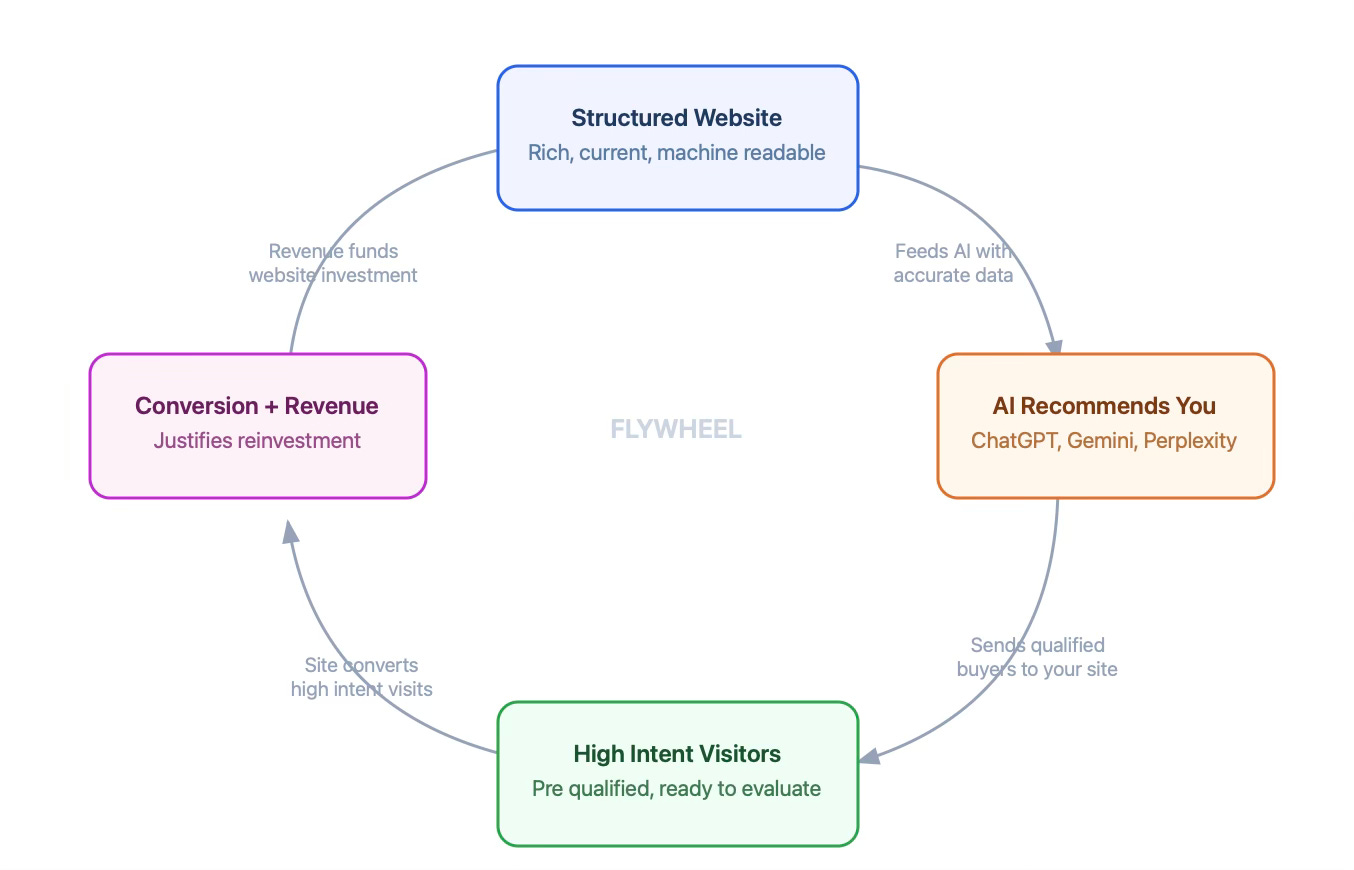
Think about how AI chatbots decide what to recommend. They pull from web content. They parse your site structure, your product pages, your documentation, your schema markup. A well maintained website with rich, structured content is exactly what makes you visible to AI chatbots. Neglect your website and you not only lose human visitors but you also become invisible to AI. Or worse, AI starts misrepresenting what you actually do because it is working with stale information.
The whole thing is a loop. Better website content feeds AI systems with accurate product information. AI systems recommend you to relevant buyers. Those buyers visit your site with real intent. Your site converts them. Revenue justifies more website investment. Cut the website budget and you break this loop at the worst possible point.
Look at Salesforce. Their website is massive. Thousands of pages of product documentation, comparison content, use case libraries, deeply structured and constantly updated. It is one of the main reasons why Salesforce is one of the most recommended CRM platforms when you ask any AI chatbot. The website feeds the machine.
What “investing in the website” actually means now
I want to be specific here because “invest in the website” is a vague phrase and most of the traditional playbook is probably wrong for this moment.
Publishing 20 blog posts a month to capture long tail SEO traffic? That was a valid strategy in 2019. In 2026, for most B2B companies, it is likely a waste of money. The informational layer is being absorbed by AI. The investment that actually matters is in three areas and they’re quite different from where most companies are spending today.
First, conversational intelligence on your own domain. When a buyer shows up after chatting with ChatGPT all day, they want to ask questions and get real answers. A well built conversational layer trained on your actual product data, pricing logic, and technical docs can do something ChatGPT genuinely cannot: give answers that are specific to your business, your current inventory, your regional availability, your compliance certifications. ChatGPT knows what you do in general terms. Your own AI should know what you can do for this specific customer right now. This is a meaningful difference.
Second, machine legibility. Your site needs to be readable by AI agents, not just by humans scrolling with a mouse. Structured data, clean taxonomy, consistent product schemas, well organized technical content. In the old world your site needed to be navigatable, meaning a person could click through menus and find things. In the new world it needs to be parsable, meaning an AI agent can pull specific data points programmatically. The companies that structure their digital presence for machine consumption are the ones that AI will recommend accurately. Everyone else gets summarized wrong or skipped altogether.
Third, experience quality at the conversion layer. If total traffic drops by 40% but the remaining visitors have twice the purchase intent, your conversion experience becomes disproportionately important. Product configurators, pricing tools, demo environments, spec sheets. This is where B2B deals actually get won or lost. A buyer who made it through the AI filtering layer and landed on your site is probably ready to engage seriously. If that experience is clunky or slow or feels generic, you are losing the highest value visitors at the highest value moment.
The real risk of pulling back
Let me walk through what actually happens when a B2B company decides to cut website investment and put that money into external “AI strategy”.
The website starts aging. Content gets stale. Product pages fall out of sync with actual offerings. Technical docs stop getting updated. The chatbot, if there was one, keeps serving outdated information. Structured data degrades quietly.
AI systems are constantly recrawling and re evaluating their sources. They notice. Your content becomes less current, less detailed, less structured than your competitors. Your share of AI recommendations starts to slip gradually. You lose recommendations you don’t even see because they happen inside someone else’s ChatGPT session.
The buyers who do still visit your site find something that feels abandoned. They compare it, probably without even thinking about it consciously, to the competitor whose site feels current and sharp. In B2B, trust is everything. A website that looks neglected raises an uncomfortable question in the buyer’s mind: if they don’t invest in their own digital presence, how much will they invest in supporting me as a customer?
I think this is the most overlooked risk in the entire debate. The website isn’t just a marketing channel. It is a trust signal. And in a world where AI pre filters options for the buyer, you get evaluated maybe two or three times instead of ten. Each of those evaluations carries more weight than it ever did before.
The compression principle
The utility web is compressing. I’ve written about this before in the context of Dopamine Web versus Utility Web. Fewer interactions overall but each one packed with more intent and consequence. B2B websites sit at the exact point where AI delegation ends and human decision making begins. The buyer used AI to research, filter, shortlist. Now they’re on your site. This is the handoff moment.
That moment is becoming the most valuable point in the entire B2B buying journey. Everything around it is getting cheaper because AI handles research at near zero marginal cost. But this specific moment is getting more expensive because fewer visits means each visit carries more revenue potential.
The right response is to make the destination where this moment happens as good as it can possibly be. Raise the experience to match the expectations that AI tools have set. Invest in conversion quality, machine legibility, conversational intelligence.
Your website is shifting from a traffic asset to a conversion asset. I am thinking more and more that the metric that matters now is revenue per session. And for the companies that understand what’s actually going on, that number is about to go way up.
Thanks for this piece, makes sense a lot